




At 11 p.m., when your key is missing or your front door will not latch properly, the smart lock vs deadbolt question stops being theoretical. It becomes about what keeps your property secure tonight, what is easiest to use every day, and what will still work when weather, batteries, or hardware issues show up.
For homeowners, renters, and property managers across Vancouver and the Lower Mainland, the right answer depends on the door, the building, and how the lock will actually be used. A smart lock can add convenience and better access control. A traditional deadbolt can offer simple, proven security with fewer points of failure. In many cases, the best setup is not one or the other, but the right deadbolt installed properly, with or without smart features.
Smart lock vs deadbolt: the real difference
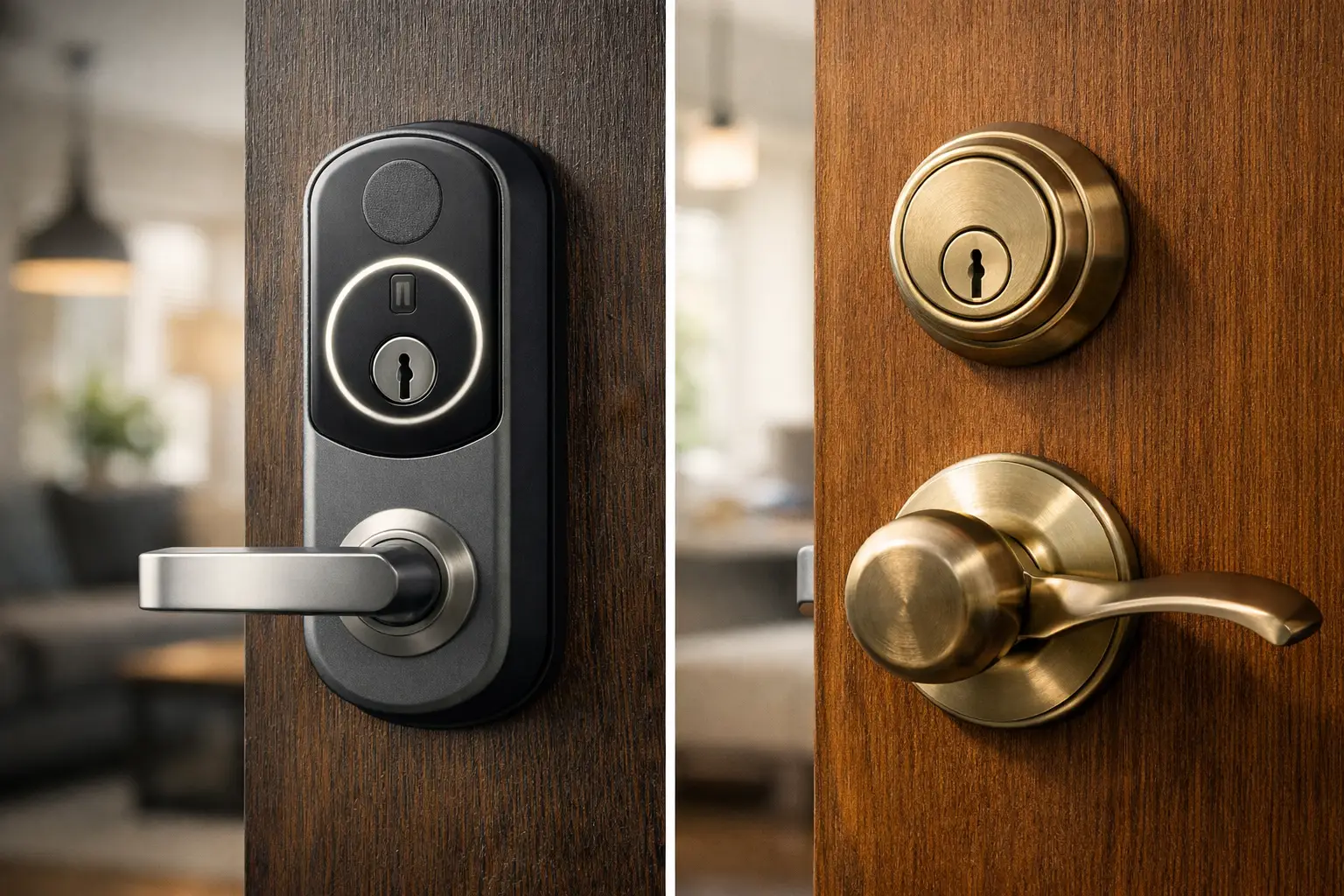
A deadbolt is a locking mechanism designed to secure a door with a solid bolt that extends into the frame. It is mechanical, straightforward, and widely used in residential and commercial settings. When people say they want a strong front door lock, they are usually talking about a good deadbolt.
A smart lock is a broader category. Some smart locks replace only the interior thumb turn on an existing deadbolt. Others replace the full lockset and add keypad, app, code, fingerprint, or remote access features. That means a smart lock is not always an alternative to a deadbolt. Sometimes it is a deadbolt with added technology.
That distinction matters. If you compare a quality deadbolt to a low-grade smart lock, the deadbolt may be the better choice. If you compare a quality smart deadbolt to a basic mechanical lock, the smart option may give you the same core protection with more convenience.
Where deadbolts still have the edge
Traditional deadbolts remain popular for a reason. They are dependable, easy to understand, and less sensitive to power issues, software glitches, or connectivity problems. If the lock is correctly installed on a solid door with a reinforced frame, a good deadbolt provides strong day-to-day protection.
For many homes, basement suites, storage rooms, and smaller commercial units, a standard single-cylinder deadbolt is often the practical choice. It does one job well. You use a key outside and a thumb turn inside. There is no app to manage and no battery warning to ignore.
Deadbolts also tend to cost less up front. Hardware is usually more affordable, and installation can be simpler when the door is already prepared for it. If your priority is reliable physical security without added features, a deadbolt is hard to dismiss.
There is also a maintenance advantage. Mechanical locks can wear out, but they are usually easier to service than electronic hardware. When a deadbolt becomes stiff, misaligned, or difficult to turn, a locksmith can often repair or rekey it without replacing the whole system.
Where smart locks make sense
Smart locks appeal to people who are tired of managing keys. For busy households, rental properties, and offices with frequent user changes, that convenience is real. You can assign codes, remove access without collecting keys, and check whether the door was locked.
That makes smart locks especially useful for property managers, short-term access situations, and families with multiple users coming and going at different hours. If a tenant moves out, an employee leaves, or a contractor no longer needs entry, changing a code is often faster than rekeying several locks.
Some smart locks also reduce the everyday problems that lead to lockouts. A keypad can help when someone forgets their key. Auto-lock features can help when the door is left unsecured. For many people, that alone is enough to justify the upgrade.
Still, convenience is not the same as better security. A smart lock can improve access control, but only if the hardware is solid, the installation is correct, and the user settings are managed properly.
Security is not just about the lock
When customers ask whether smart locks or deadbolts are safer, the honest answer is that the lock is only part of the equation. The strength of the door, the strike plate, the screws, the frame, and the alignment all affect security.
A high-end lock on a weak, poorly fitted door will not perform the way people expect. On the other hand, a properly installed deadbolt with reinforced hardware can offer better real-world protection than a more expensive smart unit installed on a compromised frame.
This is where professional installation matters. A lock that binds, shifts, or does not fully extend can create both security risks and daily frustration. In older Vancouver homes and many Lower Mainland buildings, door settling, moisture, and wear can all affect how well a lock works over time.
Smart lock vs deadbolt for reliability
Reliability is where trade-offs become clear. A standard deadbolt is simple. If the key works and the mechanism is in good condition, it usually does what it is supposed to do. There are fewer variables.
A smart lock adds more ways to enter, but it also adds more things that can go wrong. Batteries die. Wi-Fi drops. Apps fail to sync. Keypads stop responding. Fingerprint readers can be inconsistent. None of that means smart locks are a bad option. It means they need to be chosen carefully and maintained.
For a main entry door, many people want a backup plan. That might mean a smart lock with a physical key override, or a smart deadbolt from a reputable brand installed by a locksmith who can confirm proper fit and function. If the lock fails at the wrong time, convenience disappears quickly.
Cost, value, and long-term use
Up-front cost is usually lower with a standard deadbolt. Smart locks generally cost more to buy and may cost more to install, depending on the door and the hardware already in place. If you want app controls, remote access, or integration with other systems, the price goes up further.
But value depends on how you use the lock. If a smart lock saves repeated rekeying, reduces access issues, or helps manage multiple users more efficiently, it may be worth the extra cost. That is often true for rental properties, office entries, and households that need flexible access.
If you simply want a secure front door and do not need digital features, a quality deadbolt may be the better investment. Paying for smart features you will not use rarely makes sense.
Which option is better for your property?
For a detached home, a deadbolt is still a strong baseline. If you want added convenience, a smart deadbolt can work well, especially on the main entry. The key is choosing hardware that suits the door and daily traffic.
For condos and apartments, the answer can be more complicated. Building rules may limit what can be installed, and fire code or strata requirements may apply. Before replacing lock hardware, it is worth confirming what is allowed.
For rental units, smart locks can make turnover easier, but durability matters. Frequent use, battery neglect, and user error can become service calls if the hardware is not reliable.
For commercial spaces, it depends on traffic level, employee access needs, and whether you need audit trails or restricted entry by time. A basic deadbolt may be enough for some offices, while others benefit from keypad or managed access systems.
When to call a locksmith instead of guessing
If your lock is sticking, your door is misaligned, your deadbolt does not extend smoothly, or you are unsure what hardware fits your entry, it is better to have it assessed before replacing parts on your own. Many lock problems are really door or frame problems.
A locksmith can also tell you whether your current deadbolt can be upgraded, rekeyed, reinforced, or paired with a smarter access option. That matters when you want better security without overpaying for features that do not solve the actual issue.
NOW LOCKSMITH sees this often across Vancouver and surrounding communities - people replace hardware when the real problem is poor installation, worn components, or a damaged strike area.
If you are choosing between a smart lock and a deadbolt, start with how the door is used, how much control you need, and how much complexity you are willing to maintain. The best lock is the one that fits your property, works when you need it, and helps you feel secure when the door closes behind you.