



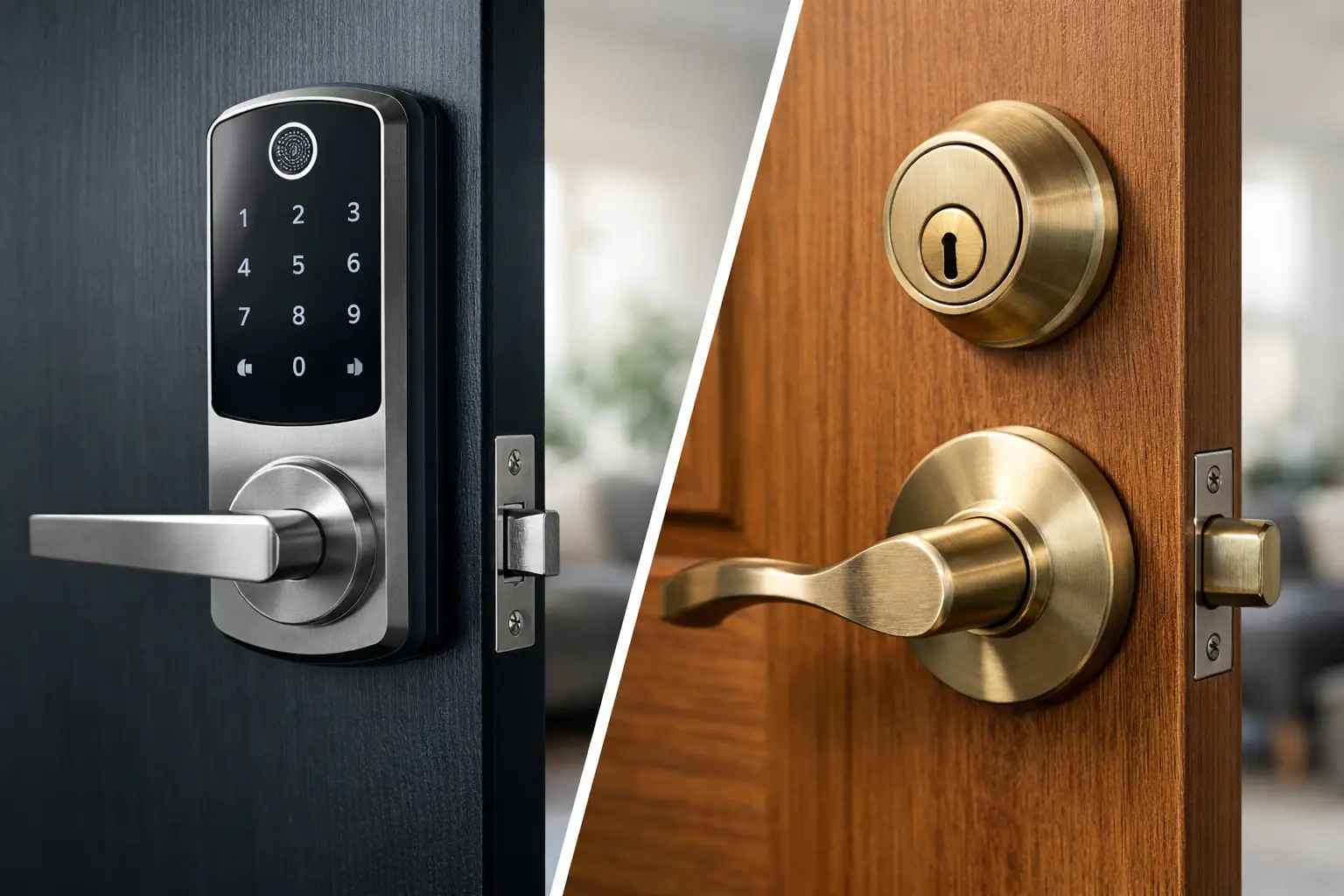
A front door lock has one job: keep the right people in and the wrong people out. Yet the choice between electronic locks vs deadbolts can feel less straightforward when convenience, security, power failures, tenants, staff, and budget all enter the picture. For Vancouver-area homes and businesses, the best answer depends on the door, the people using it, and how quickly you need access restored if something goes wrong.
Electronic locks vs deadbolts: the practical difference
A traditional deadbolt is a mechanical lock operated by a physical key on the exterior and a thumbturn or key on the interior. When installed correctly on a solid door with a reinforced strike plate, it is a proven and simple security measure. It has no battery, app, keypad, or software to maintain.
An electronic lock uses a keypad, fob, card, phone credential, fingerprint reader, or a combination of these methods. Many residential models still include a mechanical keyway as a backup. Commercial electronic locks may connect to a wider access-control system, allowing a manager to add or remove users, set access schedules, and review entry activity.
The key distinction is control. A deadbolt secures the door well but treats every key holder the same. An electronic lock can give different people different permissions without copying, collecting, or rekeying physical keys.
When a deadbolt is the better choice
A quality deadbolt makes sense when reliability and straightforward operation are the priorities. It is particularly suitable for a homeowner who wants dependable physical security without worrying about batteries, mobile apps, or user codes. It is also a strong option for exterior doors that experience heavy rain, temperature changes, or frequent use, provided the hardware is rated for the application.
Deadbolts are often less expensive to purchase and install than electronic hardware. Repairs can also be more direct. If a key is difficult to turn, the issue may be alignment, a worn cylinder, a damaged latch, or a loose strike plate. A locksmith can diagnose the mechanical problem and repair or replace the affected component.
There is a trade-off. If a key is lost, stolen, or never returned by a former tenant, contractor, or employee, the lock should be rekeyed or replaced. A copied key may also go unnoticed for years. For a rental property or a small business with changing access needs, that ongoing key management can become inconvenient and costly.
Deadbolts work well for
Deadbolts are a sensible fit for single-family homes, secondary entry doors, storage rooms, and properties where only a few trusted people need access. They are also useful where residents prefer a familiar key-operated lock and do not want another device to manage.
For best results, choose a properly rated deadbolt and make sure the installation is as strong as the lock itself. A high-quality lock cannot compensate for a weak door frame, short strike-plate screws, a loose jamb, or a door that does not close squarely.
When an electronic lock is the better choice
Electronic locks are built for access convenience. A homeowner can give a dog walker, cleaner, family member, or short-term guest a unique code instead of handing over a key. When that access is no longer needed, the code can be deleted. For many people, that is the main benefit.
For property managers, electronic locks can reduce the work involved in turnover. Rather than collecting every key and rekeying after each tenancy change, an authorized person can remove old credentials and create new ones. Local tenancy requirements and building rules still apply, so landlords should always use electronic access responsibly and protect tenant privacy.
Businesses often gain even more value. A retail shop, office, warehouse, or strata-managed common area may need to control who can enter and when. Electronic hardware can limit access to business hours, separate staff access from management access, and prevent the headache of keys circulating after an employee leaves.
Electronic locks do require attention. Most battery-powered models provide low-battery warnings, but those warnings should not be ignored. Battery contacts can corrode, keypads can wear, and some smart features rely on a stable phone connection or network. The physical door hardware still matters too: a keypad lock on a poorly aligned door may bind just as a traditional deadbolt can.
Electronic locks work well for
They are a practical option for rental units, busy households, short-term access needs, offices, retail locations, and properties where several people require controlled entry. They are also useful for people who regularly leave keys behind, as long as a reliable backup access plan is in place.
Security is more than the lock type
It is easy to assume an electronic lock is automatically more secure because it has more features, or that a traditional deadbolt is automatically stronger because it is mechanical. Neither assumption is always correct.
A well-installed deadbolt from a reputable manufacturer can provide excellent physical resistance. An electronic deadbolt can provide similar physical protection while adding code management and audit features. However, entry security is only as strong as the entire opening: the door material, hinges, frame, strike plate, glass near the lock, lighting, and habits of the people using the property all matter.
With electronic locks, use individual codes rather than one shared household or staff code. Avoid easy combinations such as a birth year, unit number, or 1234. Delete access for former users promptly, change default administrator settings, and keep any connected account protected with a strong password.
With a mechanical deadbolt, know who has keys. Rekey the lock after moving into a new home, after a break-in, after keys are lost, or whenever access control is uncertain. Rekeying changes the internal pin configuration so old keys no longer operate the lock, often without replacing all of the door hardware.
What happens during a power failure?
This concern stops many people from considering electronic locks, but most residential electronic deadbolts run on internal batteries, not household power. A neighbourhood outage usually will not prevent normal operation. The real risk is a neglected battery, not a utility interruption.
Choose a model with a clear low-battery warning and replace batteries on a schedule rather than waiting for failure. Keep the emergency backup method available. Depending on the model, that may be a mechanical key, an external battery contact, or another approved entry option. Do not hide a backup key in an obvious place near the door.
Commercial access systems are different. Wired locks, electric strikes, and maglocks may rely on building power and backup systems. The lock should be selected and installed according to fire-code requirements, life-safety needs, and whether the door must remain secured or allow exit during a power interruption. This is not a place for improvised hardware choices.
Cost, installation, and long-term maintenance
The purchase price is only part of the decision. A basic deadbolt is generally the lower-cost option, while electronic locks range from modest keypad units to commercial-grade access systems. Installation costs vary based on the door condition, borehole size, existing hardware, frame alignment, and whether new wiring or access-control integration is required.
A cheaper lock that does not fit the door properly can create repeat problems. Before choosing hardware, check door thickness, backset, handing, weather exposure, and whether the door is fire-rated. Condo buildings and commercial properties may also have rules about lock changes, keyways, or approved access systems.
Think about maintenance over several years. A deadbolt may need occasional lubrication, adjustment, rekeying, or cylinder replacement. An electronic lock needs the same physical care, plus battery changes and periodic credential management. The better value is the lock that your household or business will actually maintain correctly.
Choosing the right lock for your property
Choose a deadbolt if you want proven mechanical security, have a small number of key holders, and prefer the lowest-maintenance setup. Choose an electronic lock if you need flexible access for family, tenants, guests, staff, or contractors and are prepared to manage batteries and codes.
In some cases, the best setup is both. A home may use an electronic deadbolt on the main entry for daily convenience and a traditional deadbolt on a less-used side or garage entry. A business may use electronic credentials at staff doors while retaining restricted mechanical key control for certain areas.
If the door is damaged, the latch is sticking, a key has been lost, or an electronic lock is no longer responding, avoid forcing it. A professional inspection can determine whether the issue is the lock, batteries, alignment, wiring, or the door frame. NOW LOCKSMITH provides 24/7 assistance across Vancouver and the Lower Mainland for lockouts, repairs, rekeying, and new lock installation.
The right lock should make daily access easier without creating a weak point or a new emergency. Start with the people who need entry, the door they use, and the backup plan you can rely on at any hour.