





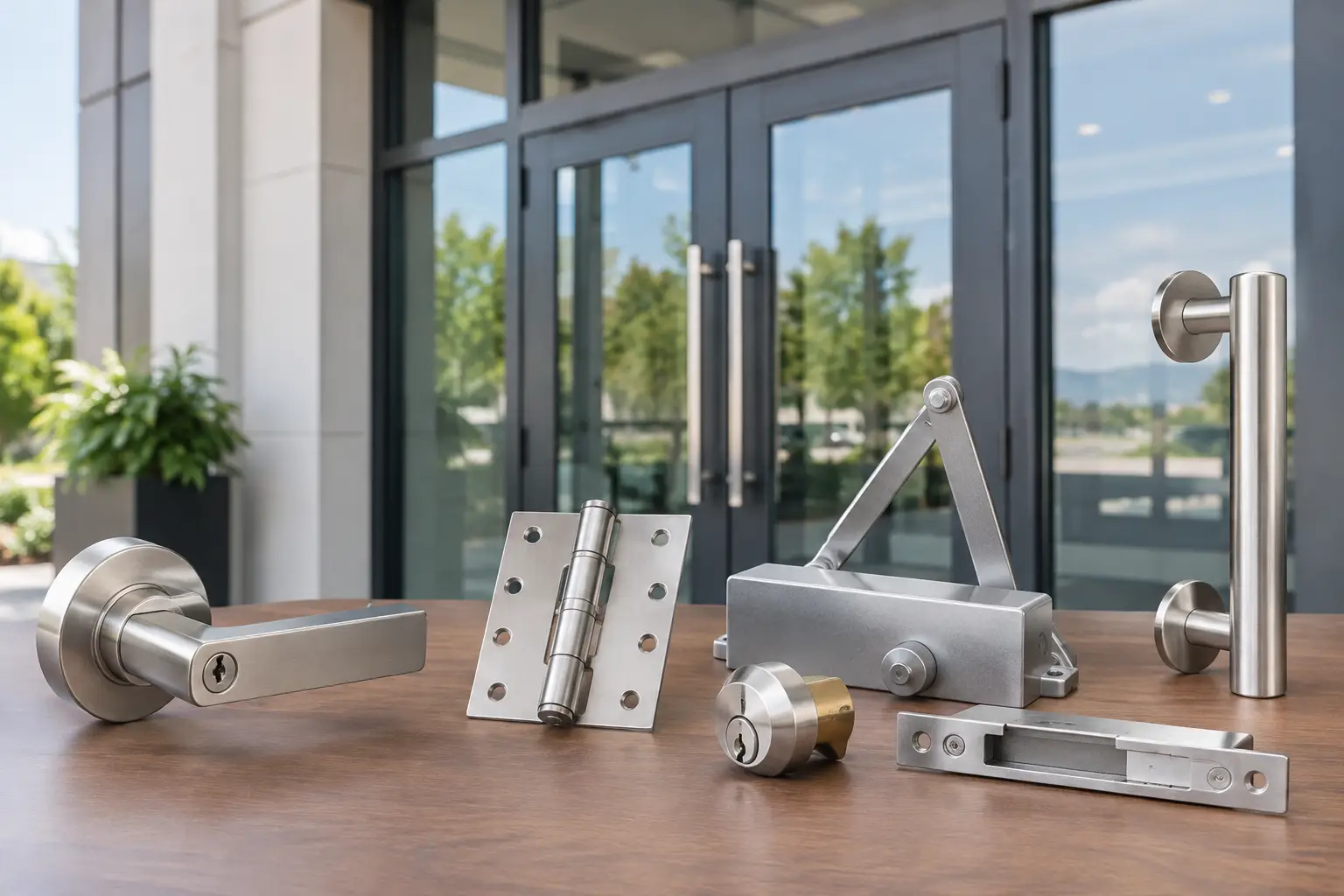
A storefront door that does not latch, a rear exit with a damaged panic bar, or an office lock that keeps sticking can interrupt business immediately. The best commercial door hardware options are not simply the strongest products on the shelf. They are the components that suit your door, occupancy, traffic level, fire-rating requirements, and daily security needs.
For businesses across Vancouver and the Lower Mainland, the right choice usually comes down to balancing life safety, durability, staff convenience, and control over who can enter. A busy restaurant has different needs than a medical clinic, warehouse, strata building, or small retail unit. Choosing hardware as a system, rather than replacing one failed part at a time, helps avoid repeat service calls and weak points at the door.
Best Commercial Door Hardware Options by Function
Commercial doors work hardest at the points people touch every day: the lock, lever, closer, hinges, exit device, and frame. If any one part is undersized or poorly fitted, even quality hardware can fail early.
Commercial-grade lever locks and cylindrical locks
Commercial lever locks are a practical option for many interior offices, staff rooms, clinics, storage areas, and light-use exterior doors. They are easier to operate than knobs, meet accessibility needs more readily, and are available with different keying and function options. A passage lever suits doors that do not need to lock, while a storeroom function keeps the exterior lever locked and requires a key or credential for entry.
Cylindrical locks are often cost-effective for moderate traffic, but they are not the best fit for every entrance. On a heavily used front door, a narrow-frame aluminum door, or a location exposed to forced-entry attempts, a higher-duty mortise lock or exit device may be the better long-term investment.
Mortise locks for busy and higher-security doors
A mortise lock fits into a pocket cut into the door edge. It is a more substantial type of lockset that can combine a latch, deadbolt, lever trim, and cylinder in one assembly. This makes it a strong choice for office entrances, commercial suites, schools, institutional buildings, and other high-traffic locations.
The trade-off is cost and installation complexity. Retrofitting a mortise lock into a door prepared for a cylindrical lock requires careful door preparation, and mistakes can permanently affect the door. When a door sees constant use or protects valuable equipment, however, mortise hardware can provide better durability and a more professional operating feel.
Panic bars and fire exit hardware
Panic bars, also called exit devices, are essential on many commercial exit doors. A horizontal push bar allows occupants to leave quickly without needing keys, codes, or fine motor control. They are common on restaurant exits, retail back doors, warehouses, schools, assembly spaces, and doors with higher occupant loads.
Not every push bar is the same. Rim exit devices mount on the face of the door and are common on single doors. Vertical rod devices secure the top and bottom of a pair of doors. Mortise exit devices offer a clean, durable option where the door and frame are prepared for them. The correct choice depends on the door configuration, fire label, required latching, and local code requirements.
Do not replace an exit device with standard locking hardware just because the existing panic bar is damaged. Exit doors must allow safe egress. Any work on fire-rated doors and exit hardware should be assessed carefully so the door continues to close, latch, and function as intended during an emergency.
Door closers that protect the whole opening
A commercial door closer controls how a door closes after someone enters or exits. It may look like a small detail, but it protects security, energy efficiency, fire separation, and the life of the lock. A door that slams can damage frames and hardware. A door that closes too slowly, or stops short of latching, can leave a business unsecured.
Surface-mounted hydraulic closers are widely used because they are dependable and serviceable. They can be adjusted for closing speed, latching speed, and backcheck, which cushions the door when it is opened forcefully. For storefronts, offices, and public entrances, choose a closer sized for the weight, width, and wind exposure of the door. A closer that is too weak will not latch the door reliably. One that is too strong can make access difficult for customers and employees.
Continuous hinges and heavy-duty pivots
Hinges carry the full weight of the door, and worn hinges often cause symptoms that appear to be lock problems. A sagging door may scrape the threshold, miss the strike plate, or prevent a deadbolt from extending smoothly. Replacing only the lock will not correct the alignment issue.
Continuous hinges run nearly the full height of the door and distribute weight across a larger area. They are well suited to high-use aluminum storefront doors, institutional settings, and doors that have started to sag. Heavy-duty ball-bearing hinges and pivot systems can also be appropriate, depending on the frame and door design. The best option is the one compatible with the existing opening and expected daily traffic.
Commercial Door Hardware Options for Access Control
Physical keys remain useful, but many businesses need more control than a standard key system can provide. Electronic access control can limit entry by employee, time of day, department, or location. It also reduces the disruption caused when a staff member loses a key or leaves the company without returning it.
For a small office, a keypad or standalone electronic lever may be enough. It allows a code to be changed without rekeying the door. For businesses with several staff, restricted areas, or multiple locations, card, fob, mobile credential, or cloud-managed systems offer better oversight. These systems can create an audit trail and allow credentials to be removed quickly.
Access control still depends on sound mechanical hardware. An electric strike, magnetic lock, electrified lever, or delayed-egress device must be matched to the door type and the building's egress requirements. On an exit route, the door must continue to permit safe release during emergencies and power interruptions where required. A qualified assessment before installation helps prevent costly changes later.
Key Control Is Part of the Security Plan
A high-quality lock offers limited protection if too many copies of the key are circulating. Master key systems can give managers access to multiple doors while limiting staff access to specific rooms. Restricted keyways add another layer of control by limiting unauthorized duplication.
This arrangement works best when the key schedule is planned before hardware is installed. Consider who needs access to exterior doors, offices, electrical rooms, supply closets, tenant spaces, and mechanical areas. For property managers, a structured master key system can reduce key clutter while preserving separation between units or departments.
There is a trade-off. More complex master key systems require careful records and professional maintenance. If keys are lost, staff changes are frequent, or the property has experienced a break-in, rekeying or updating access credentials should be handled promptly rather than postponed.
How to Choose Hardware for Your Building
Start with the door itself. Is it wood, hollow metal, aluminum storefront, glass, or fire-rated? Is it a single door, paired doors, or a door with a narrow stile? The existing preparation, frame condition, and door alignment determine which products can be installed properly.
Next, consider use. A rarely used storage-room door does not need the same hardware as a customer entrance opened hundreds of times per day. Exterior doors also need hardware that can tolerate weather, temperature changes, and attempts at forced entry. In Vancouver's wet climate, corrosion resistance and proper adjustment matter, especially at exposed rear exits and loading areas.
Finally, think about what happens when something goes wrong. A reliable closer, properly aligned latch, and durable exit device reduce the likelihood that your staff will be dealing with a door that will not lock at closing time. For urgent repairs, lockouts, damaged exit hardware, or commercial lock installation in Vancouver and surrounding communities, NOW LOCKSMITH can assess the opening and help restore secure access at any hour.
The right commercial hardware should make the door feel uneventful: it opens easily for authorized people, closes securely behind them, and lets everyone exit safely when they need to.